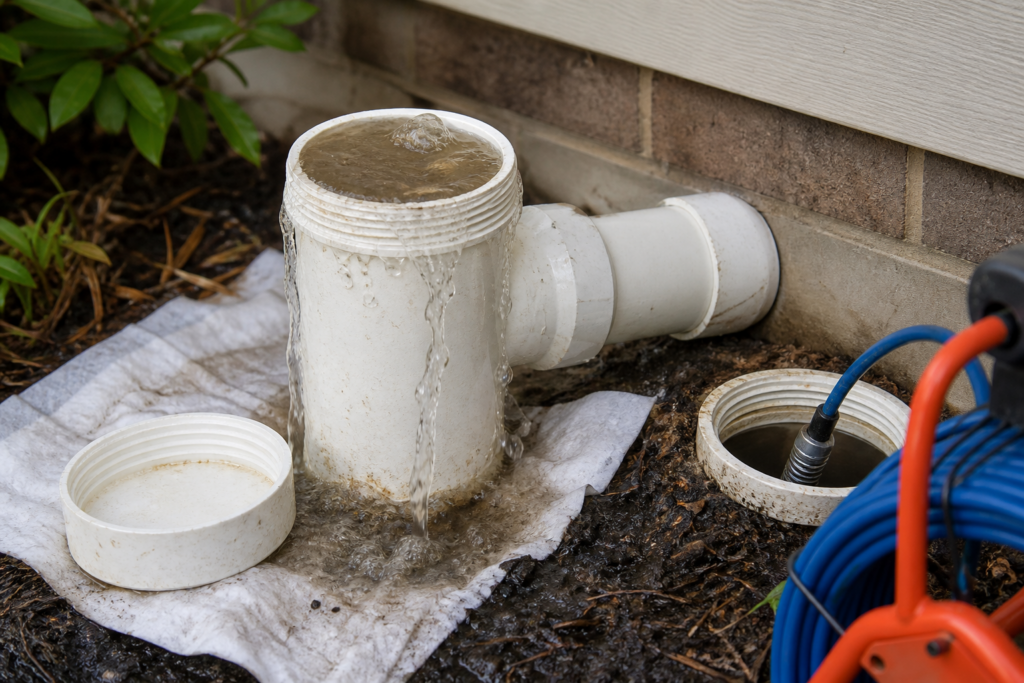
If a sewer cleanout overflows when a toilet is flushed, the new wastewater is reaching the cleanout but cannot continue through the line normally. That sequence usually points to a restriction farther downstream from the cleanout. The cause may be a removable blockage, roots, heavy buildup, displaced pipe, a sagging section, or other sewer-line damage, but the overflow alone cannot identify which one.
Stop flushing toilets and avoid running sinks, showers, tubs, dishwashers, or washing machines until the flow path has been evaluated. Every gallon entering the drainage system can add to the spill.
Keep People Away and Stop Adding Wastewater
Treat anything leaving a sanitary sewer cleanout as contaminated. Keep children and pets away, avoid skin contact, and do not walk through the affected soil or track it indoors. If wastewater reaches a living area, electrical equipment, a well area, or another sensitive location, isolate the area and follow appropriate public-health, sanitation, or emergency guidance for the condition.
Do not force the cap back onto an opening that is actively overflowing. Closing a pressurized or backed-up access point can redirect wastewater toward a lower drain, toilet, tub, or weak connection inside the building. Leave the opening and surrounding equipment alone for the plumber to assess.
Do not pour chemical drain cleaner into a toilet or cleanout. It will not show whether the line has roots, a broken section, or a sag, and the chemical can remain in backed-up water where it creates an exposure risk for anyone inspecting or clearing the pipe.
The Flush Sequence Helps Locate the Restriction
A toilet releases a large amount of water into the drain over a short period. When the pipe is open, that flow travels past the cleanout and continues through the building sewer. When water rises at the cleanout immediately after the flush, the access point is acting as the first visible relief point upstream of a restriction.
The cleanout’s position matters. A plumber needs to trace which fixtures drain past that point, which direction the fitting faces, and where the line continues. An exterior cap near the foundation may serve a different section than an indoor or branch cleanout. The same visible symptom can therefore have a different source in two homes.
The timing also matters. An immediate surge after one flush suggests that the available pipe volume is already limited. A level that rises only after several fixtures run may indicate a partial restriction that temporarily accepts some flow. Neither pattern proves what is inside the pipe, but both help define where testing should begin.
A Removable Blockage Is One Possibility
Paper, hygiene products, wipes, grease, sediment, and other material can reduce or close the usable diameter of a sewer line. Some blockages develop gradually and first show up as slow drains or occasional gurgling. Others move or compact until a toilet flush can no longer pass.
Clearing may restore flow when the pipe itself remains serviceable. The correct method depends on the material, location, access, and condition of the line. A powered cable, root-cutting tool, or water-jetting equipment should not be selected from the surface symptom alone.
Jacob’s Plumbing LLC provides sewer line repair and replacement in Pelzer when testing shows that the problem extends beyond an ordinary fixture clog. The recommendation should connect to observed pipe and flow conditions, not the overflow by itself.
Roots Can Return After Flow Is Restored
Roots enter through a defect or vulnerable joint rather than growing through sound pipe walls. Once inside, they can catch paper and debris, creating a restriction that becomes more severe over time. Cutting the root mass may reopen the line, but it does not remove the opening that allowed roots to enter.
That is why recurrence history matters. Note whether the line has been cleared before, how long relief lasted, and whether the same cleanout overflowed during the earlier problem. Repeated clearing at the same location may justify a camera review after the line can carry enough water for the lens to see.
Visible roots near the cleanout do not prove that roots are inside the sewer. Likewise, trees in the yard do not establish the cause. The pipe interior and location of the restriction need direct evidence.
A Sag, Separation, or Damaged Pipe Can Produce Similar Symptoms
A low section can hold water and debris, a separated joint can interrupt flow, and a crushed or collapsed section can reduce the opening. Older material, soil movement, poor support, or previous work may contribute, but age and yard conditions alone are not a diagnosis.
Structural trouble becomes more plausible when clearing does not restore normal flow, equipment repeatedly stops at the same measured distance, or a camera shows standing water, offset joints, deformation, or a break after the blockage is removed. A camera pushed into opaque backed-up water may not provide a useful view, so restoring controlled flow can be the first step.
A condition-led sewer camera inspection can document the interior and help distinguish remaining buildup from a specific damaged section. The camera evidence should be paired with distance and surface location before repair scope is discussed.
General Drain Backups and Cleanout Overflow Are Not Identical
One slow sink often points toward a local fixture or branch problem. Several affected fixtures, a low shower or tub that backs up, and an exterior cleanout that spills after toilet use shift attention toward a shared downstream line.
The existing guidance on recurring drain clogs in Greer and Pelzer can help organize which fixtures are affected and whether a problem returns after cleaning. For an active cleanout overflow, the immediate priority is simpler: stop adding water and preserve the trigger information for diagnosis.
Do not keep flushing different toilets to compare them. One clear observation is useful; repeated testing adds wastewater and can move the backup into the home.
Safe Details to Record Before the Appointment
Useful observations can be made without touching the wastewater or opening another fitting:
- Note which toilet or fixture was used just before the cleanout rose.
- Record whether the rise was immediate or delayed.
- Note whether the water level drops when all water use stops.
- List any slow, gurgling, or backed-up fixtures inside the home.
- Record recent sewer cleaning and how long the improvement lasted.
- Photograph the cleanout and overflow area from a safe, dry position.
- Note recent excavation, heavy vehicle traffic, landscaping, or ground movement near the line.
- Record whether the condition follows heavy rain, while avoiding a conclusion about the cause.
- Keep children and pets out of the area until it has been handled appropriately.
Do not remove additional caps, insert a hose, reach into the cleanout, or run rented equipment. Those actions can release more wastewater, damage the pipe, or erase evidence about where the restriction begins.
What a Professional Sewer Diagnosis May Include
The plumber should first confirm the cleanout’s direction, the fixtures that connect upstream, and whether the line can be accessed without increasing the spill. Depending on the condition, the evaluation may include:
- Observing the water level with all fixtures off.
- Adding a controlled amount of water only when it can be done safely.
- Measuring where a cable or cleaning head meets resistance.
- Clearing enough of the restriction to restore controlled flow.
- Inspecting recovered material without assuming it is the only cause.
- Running a camera after visibility is available.
- Recording defects, standing water, offsets, roots, or deformation by distance.
- Locating a verified problem from the surface before proposing excavation.
- Re-testing flow after cleaning or repair.
A clean line and a structurally damaged line require different decisions. The diagnosis should explain which evidence supports cleaning, monitoring, a focused repair, or replacement.
Cleaning and Repair Solve Different Problems
Cleaning removes material that is restricting flow. Repair corrects a defined defect in the pipe. Replacement becomes a reasonable discussion only when the verified condition, access, material, damage extent, and expected repair durability support it.
If normal flow returns and the camera shows a serviceable pipe, cleaning and future monitoring may be sufficient. If the same location contains an offset, collapse, severe root entry, or persistent standing water, a focused repair may be considered. Widespread or inaccessible damage may lead to a broader replacement discussion, but the cleanout overflow itself does not set that scope.
Ask for the measured location and recorded condition behind any repair recommendation. A clear explanation should connect the proposed work to what the line actually shows.
Request Sewer-Line Service in Pelzer
When a toilet flush sends wastewater out of a sewer cleanout, stop water use and keep people away from the spill. Contact Jacob’s Plumbing LLC to arrange a sewer-line evaluation that traces the flow path, clears the restriction when appropriate, and documents pipe condition before repair scope is decided.