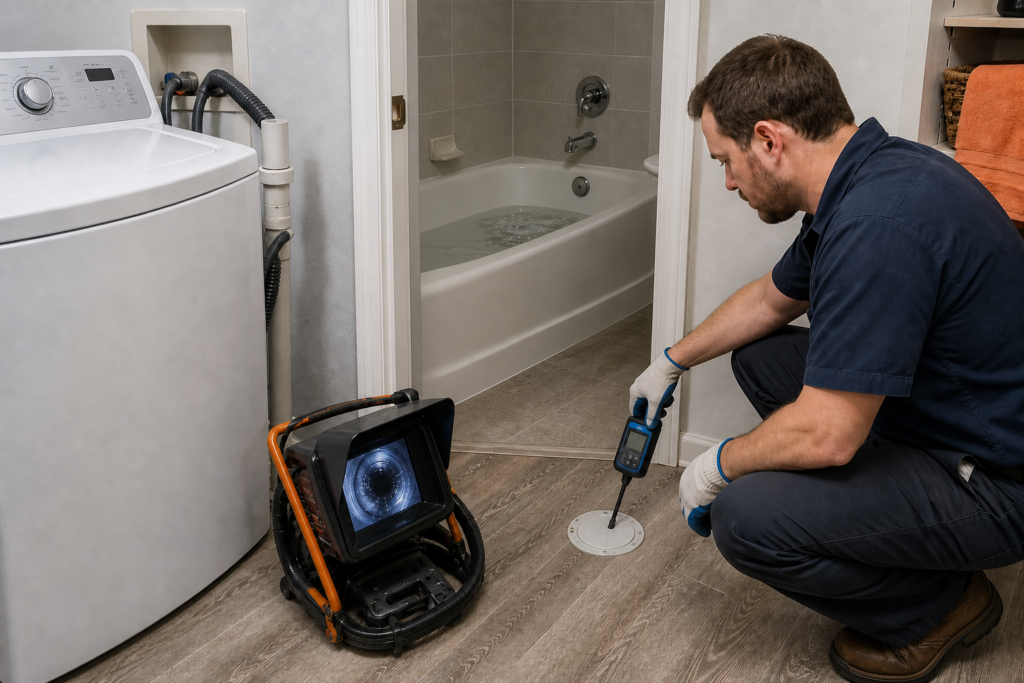
If water rises or gurgles in the bathtub while the washing machine pumps out, the washer’s discharge is meeting resistance somewhere after the laundry and tub drain paths join. The bathtub is often one of the lowest open fixtures, so it can become the visible relief point when the shared drain cannot carry the washer’s flow normally. The sequence identifies a useful place to begin diagnosing, but it does not prove what is in the pipe or exactly where the restriction sits.
Stop the washer and avoid running water through the affected laundry and bathroom fixtures. If other drains or toilets are also slow, gurgling, or rising, reduce water use throughout the home until the drain path is evaluated. Do not run another cycle to test it, add chemical cleaner, or touch backed-up water.
The Washer’s Pump-Out Phase Exposes a Limited Drain Path
A washing machine releases water into its standpipe over a relatively short period. A clear drain accepts that flow without changing the water level in a nearby tub or shower. When the shared path is restricted, the incoming volume can temporarily exceed the pipe’s available capacity.
The water then looks for another opening upstream of the restriction. A bathtub drain sits low to the floor and may show the problem before a sink does. You may hear bubbling first, see the tub drain ripple, or watch water rise around the opening during the washer’s drain or spin phase.
That timing matters. A tub that responds only when the washer pumps out provides different evidence from a tub that drains slowly every day. It also differs from an exterior sewer cleanout that spills when a toilet flushes. Preserve the exact indoor fixture sequence instead of assuming every backup has the same source.
A Shared Branch Restriction Is One Possibility
Laundry and bathroom fixtures may connect to a common branch before that pipe joins a larger building drain. If the washer and one nearby tub are the only affected fixtures, a restriction in that shared branch is plausible. Accumulated residue, lint, hair, or other material may reduce the usable opening, but the surface symptom cannot identify the material.
The layout of the home matters. Fixtures that appear close together may not follow the same route behind the walls or below the floor. A plumber needs to trace the connections rather than rely only on room location.
Professional drain cleaning in Pelzer should match the actual access, pipe condition, and location of the restriction. The washer-to-tub response helps define the starting area; it does not choose the equipment or prove that one cleaning method fits every home.
Several Affected Fixtures Point Farther Downstream
The likely search area changes when more fixtures react. If another tub, shower, toilet, or sink also gurgles or rises, the limited section may be after several branches join. A lower fixture on another side of the home can be especially useful evidence.
Multiple affected fixtures do not automatically mean the exterior sewer is broken or that replacement is needed. A removable restriction can create a broad backup, and a partially open pipe may still carry small amounts of water before a washer discharge exposes the limitation.
Make a list of what was already slow before the washer event. Note whether a toilet bowl level changed, whether another low drain made noise, and whether the condition has happened during earlier laundry cycles. Do not flush or run more fixtures to expand the test.
Gurgling Alone and Water Rising Are Different Clues
Gurgling can occur when water and air move through a restricted drain path. Venting conditions can also affect sound. If the bathtub only makes a brief noise and no water level changes, the plumber may need to consider both drainage and air movement.
Actual water rising from the tub drain shows that flow is reaching the fixture opening from the drain side. That is a stronger reason to stop adding water. The color, odor, or amount does not make the water safe to touch, and a clear appearance does not prove that it contains only laundry water.
Record whether you heard a few bubbles, saw a shallow ring of water, or observed continuing rise after the washer stopped. Those distinctions are more useful than guessing which pipe is blocked.
Stop Adding Water and Keep the Area Undisturbed
Pause or cancel the washer without stepping into wet flooring or handling electrical equipment near water. Leave the bathtub unused. If a toilet, sink, or shower in the same area is also involved, avoid using it.
Keep children and pets away from the tub and any wet floor. Do not reach into the drain, handle residue, or try to identify the water by smell or touch. If water has reached outlets, cords, appliances, or another electrical source, stay out of the wet area and seek appropriate assistance rather than unplugging equipment from within it.
The level may drop after the washer stops because the restricted line is still passing some water. That does not confirm that the problem is gone. Another high-volume discharge can refill the tub or move the backup to a different low fixture.
Useful Observations Do Not Require Another Test
Write down what already happened while the sequence is fresh:
- Note whether the tub reacted during wash, drain, rinse, or spin.
- Record whether the response was immediate or delayed after the pump started.
- Note whether the water stopped rising as soon as the washer stopped.
- List every fixture that was slow, noisy, or affected before the event.
- Record whether the tub normally drains at a typical rate when the washer is off.
- Note any recent laundry, bathroom, flooring, or plumbing work.
- Record prior drain cleaning and how long the improvement lasted.
- Photograph the tub, standpipe area, and visible water from a safe, dry position.
- Note an unusual odor or visible residue without approaching or touching it.
These details help a plumber map the probable shared path and decide which accessible point should be inspected first. A single observed event is enough; repeating it adds water without adding much reliable information.
Avoid Chemical Cleaner and Improvised Equipment
Chemical drain cleaner cannot show whether the limited section is near the tub, near the laundry connection, or farther downstream. It may remain in backed-up water and expose anyone who later opens or cleans the line. Do not pour it into the bathtub, washer standpipe, toilet, or another drain.
Do not remove a floor cleanout cap, disconnect the washing-machine hose, dismantle the tub trap, or insert a rented cable. Opening the wrong point can release water into the room, and powered equipment can damage a vulnerable pipe or cause injury.
Plunging one fixture can also move backed-up water or pressure toward another opening. If any chemical product has already been used, tell the plumber what it was and where it entered before work begins.
A Restriction Near the Laundry Connection Can Affect the Tub
The washer standpipe, trap, and branch must carry fast pump discharge without overflowing. A restriction downstream of that connection can slow the water enough for it to seek the nearby tub opening. The exact junction may be inside a wall, below a floor, or farther along the branch.
A standpipe that overflows at the top is a different visible symptom from a tub that rises, although both can involve limited drainage. Note which opening showed water first. Do not assume the hose is installed incorrectly or move it based only on the tub response.
If the washer has drained normally for a long time and the bathtub response is new, a changing drain condition is worth investigating. If it has happened since an installation or remodel, the connection layout and work history become especially important evidence.
Recurrence Changes the Diagnostic Decision
A line that was recently cleared but produces the same cross-fixture response deserves a closer look at where resistance returns. The interval matters: relief lasting days suggests a different decision from years of normal service.
Prior recurring drain-clog guidance for Greer and Pelzer can help organize cleaning history and affected fixtures. For the current washer-to-bathtub event, keep the focus on the exact trigger, the branch pattern, and whether normal flow was ever confirmed afterward.
Recurring symptoms still do not prove pipe damage. They tell the plumber that clearing flow alone may not fully explain why the same section becomes limited again.
How a Plumber Traces the Shared Drain
The evaluation begins by confirming which fixtures connect to the affected path. The plumber may review the room layout, visible piping, accessible drain points, and timing you recorded. A controlled test should occur only when the area can contain the water safely.
Cleaning equipment is selected for the pipe size, access, and observed condition. The plumber can measure where resistance occurs, inspect material recovered during cleaning, and verify whether the tub remains stable when controlled flow is restored.
When location or recurrence remains uncertain, a condition-led sewer camera inspection may help document the interior after enough flow is available for a useful view. A camera is not automatically the first step for every branch clog, and opaque backed-up water may limit what it can show.
The result should connect the recommended work to observed flow, measured location, and pipe condition rather than to the bathtub backup alone.
Restored Flow Should Be Verified at Both Fixtures
Successful service should do more than make the tub water disappear. The drain path should accept controlled washer discharge without making the bathtub gurgle or rise. The tub should also drain normally on its own, and nearby fixtures should remain stable.
If the line carries water normally after cleaning and no additional condition is found, monitoring may be appropriate. If the same response returns, record how soon it happened and whether the affected-fixture pattern changed.
Do not restart the washer until the plumber confirms that the drain can accept the discharge and the affected area has been handled appropriately. Water that receded before the appointment is not a substitute for that confirmation.
Request Drain Cleaning in Pelzer
When a washing machine makes the bathtub back up, stop the washer, avoid affected fixtures, and keep away from the water. Contact Jacob’s Plumbing LLC to schedule a Pelzer drain evaluation that traces the shared fixture path, clears the restriction when appropriate, and verifies flow before normal laundry use resumes.