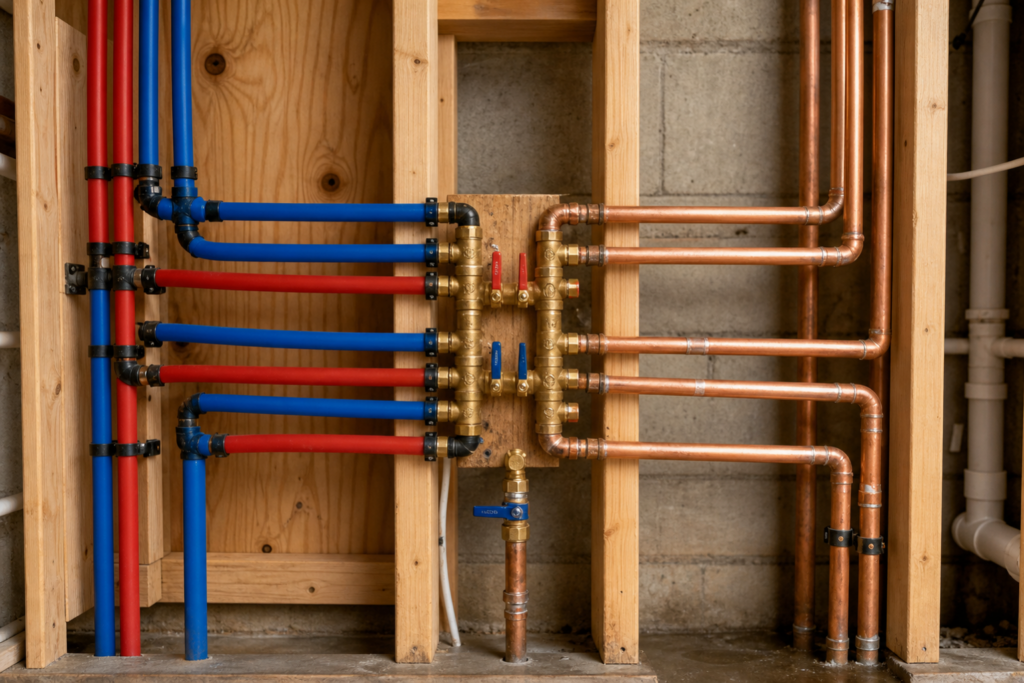
PEX and copper can both be appropriate for a whole-house repipe. The better choice depends on the existing piping, the routes available through the home, fixture connections, exposed conditions, verified water concerns, and the requirements of the complete installation system. A material should be recommended only after the plumber inspects the property and explains how the proposed layout will work.
The decision is not simply flexible pipe versus rigid pipe. Fittings, supports, shutoff valves, transition points, access openings, pressure testing, electrical considerations, and finish repairs all affect the finished result. A clear proposal should describe those details instead of naming a material without explaining the system around it.
How PEX Works in a Whole-House Repipe
PEX is flexible plastic supply tubing installed as part of a compatible fitting and connection system. Its flexibility can allow longer runs with fewer directional fittings than rigid pipe, particularly when a route must pass through framing or other limited-access areas.
Red and blue tubing is commonly used to help distinguish hot and cold lines, but the color does not change the tubing’s function. The installer still needs to size each run, protect it where it passes through framing, support it correctly, avoid damaging bends, and use fittings and connection tools approved for the selected system.
A PEX layout may use branches similar to a conventional piping system or a manifold that provides more direct fixture runs. Neither approach is automatically correct for every house. A manifold needs an appropriate location and accessible shutoffs, while a branched layout must still provide sensible isolation and balanced routing.
PEX must also be protected from conditions the selected product is not designed to tolerate. Routing near heat sources, prolonged ultraviolet exposure, sharp edges, and vulnerable penetrations requires careful planning. The plumber should identify those conditions before choosing the route.
How Copper Works in a Whole-House Repipe
Copper is rigid metal piping assembled with compatible fittings and approved joint methods. It creates straight, stable runs and is often easy to recognize and inspect when installed in exposed mechanical areas.
Because copper does not flex around obstacles, the route may require more fittings and more direct access through walls, ceilings, floors, or crawl spaces. That does not make it a poor choice; it means access and joint placement are important parts of the scope. A well-planned copper installation keeps joints accessible where practical, supports the pipe, protects it at framing penetrations, and allows for normal movement and expansion.
The condition of existing copper is relevant but does not by itself prove that all new copper will behave the same way. Repeated leaks can involve material age, workmanship, external contact, electrical conditions, pressure, or water characteristics. The cause should be investigated before assuming a material change will solve every problem.
Access and Routing Often Shape the Recommendation
A plumber should trace how the main supply can reach bathrooms, the kitchen, laundry connections, hose connections, and the water heater without creating unnecessary demolition or vulnerable pipe runs. Flexible PEX may simplify some concealed routes, while copper may fit naturally in exposed or mechanically protected areas.
The best plan can also use carefully designed transitions when appropriate. A home does not always need one material in every exposed connection, but every transition should use a compatible fitting and remain placed where it can be inspected or serviced when practical.
Ask the plumber to show the proposed main route, important branches, shutoff locations, and areas that require access openings. If the proposal leaves those details unclear, comparing material prices alone will not reveal the true scope of the work.
Existing Pipe Condition Should Be Documented
Before a whole-house repipe, the plumber should identify the visible pipe materials and inspect accessible sections for corrosion, staining, mineral buildup, damaged fittings, prior repairs, unsupported runs, and active leaks. The pattern matters. One damaged fitting presents a different decision from repeated failures across unrelated parts of the supply system.
Homeowners who are still deciding whether the project is necessary can review the common signs a Pelzer home may need a whole-house repipe. Those warning signs support an inspection, but they do not determine whether PEX or copper is the right replacement material.
The evaluation should also separate the home’s interior supply piping from an underground or exterior main-water-line problem. Replacing interior branches will not repair a leaking buried service line, and replacing an exterior line will not correct failing branches throughout the house.
Water Evidence Matters More Than Assumptions
Discoloration, scale, staining, or pinhole leaks may raise questions about water conditions, but appearance alone cannot identify the cause. Municipal work, private plumbing corrosion, sediment, treatment equipment, or another condition may create similar symptoms.
When water quality or corrosion is part of the concern, the recommendation should use suitable current evidence. That may include inspection findings, property-specific water information, or qualified testing. The findings can help the plumber assess compatible materials, fittings, valves, and any treatment equipment already serving the home.
Do not accept a universal claim that one pipe material solves every water issue. Material selection should follow the evidence found at the property and the product requirements for the proposed system.
Connections and Fittings Are Part of the Material Choice
PEX is not one interchangeable product. Connection methods and fitting systems have specific tools, components, and installation requirements. Copper joints also require an appropriate approved method and careful preparation. The quality of those connections is as important as the pipe between them.
A written scope should name the proposed pipe and fitting system, explain important transitions, and identify where new isolation valves will be installed. It should also address fixture stops, hose connections, water-heater connections, pressure-regulating components when present, and the main shutoff.
Mixing incompatible components or using improvised transitions can create future failure points. A professional installation should use a complete, supported system rather than a collection of parts selected only by what fits together temporarily.
Electrical Bonding and Grounding Need Professional Review
Metal water piping can be involved in a home’s electrical bonding arrangement. Replacing metal piping with nonmetallic tubing may change the continuity of that path. This is not a do-it-yourself detail and should not be handled by guessing where a clamp belongs.
The repiping scope should account for existing bonding and grounding conditions and coordinate qualified electrical evaluation when required. Choosing PEX does not remove the need to review this issue, and choosing copper does not guarantee that the existing arrangement is correct.
Noise and Movement Depend on the Installation
Homeowners sometimes choose a material because they expect it to eliminate pipe noise. Banging, ticking, or movement can involve pressure changes, fast-closing valves, temperature changes, loose supports, or inadequate air chambers or arrestors. Pipe material can affect how sound travels, but installation and system conditions still matter.
The plumber should investigate existing noise separately and plan proper supports, clearance, protection, and pressure control. A repipe should not simply conceal the same pressure or valve condition behind new walls.
Compare the Complete Scope, Not Just the Pipe
Two repiping proposals may use the same material and still describe very different projects. Before comparing them, confirm whether each scope includes:
- The main supply route and all intended fixture branches.
- The specific pipe, fitting, and connection system.
- New shutoff valves and accessible isolation points.
- Required access openings and who is responsible for finish repair.
- Protection at framing penetrations and exposed areas.
- Removal or abandonment of old piping where appropriate.
- Pressure and leak testing before walls are closed.
- Review of the main shutoff, pressure regulation, and water-heater connections.
- Cleanup, documentation, and any project-specific inspection steps.
A lower number that excludes access repair, valve replacement, or important fixture connections may not be directly comparable with a complete scope. Ask for unclear exclusions to be explained in writing.
What a Repiping Inspection Should Clarify
Jacob’s Plumbing can evaluate the existing system through its water line repair and replacement service. A useful inspection should clarify whether the concern is isolated or system-wide, which supply lines are included, what routes are practical, and which conditions influence material selection.
The plumber should be able to explain:
- Why PEX, copper, or a planned combination fits the observed conditions.
- How the proposed pipe sizes and routes serve the fixtures.
- Where fittings, manifolds, transitions, and valves will be located.
- How vulnerable areas will be supported and protected.
- What testing will confirm the new system is ready for use.
- What work is excluded from the proposal.
If inspection findings show that targeted repair is more appropriate than a full repipe, the scope should say so. A whole-house replacement should solve a documented system problem, not be treated as the automatic answer to every leak.
Prepare Your Pelzer Home for a Clear Repiping Decision
Before the visit, note where leaks, pressure changes, discoloration, or pipe noise have appeared. Gather any prior repair records and identify finished areas where access would be especially disruptive. Do not open walls or disturb pressurized piping just to investigate.
If you are comparing PEX and copper for a Pelzer whole-house repipe, contact Jacob’s Plumbing to request a property-specific evaluation. Ask for a written scope that connects the material recommendation to the existing system, proposed routes, connection method, access needs, and final testing so you can compare the complete installation with confidence.