Most homeowners in Greer, SC don’t think about backflow until something goes wrong — and by then, the problem is already inside your water supply. Backflow is one of those plumbing issues that sounds technical until you realize what it actually means: contaminated water flowing backward into the clean water you and your family drink, cook with, and bathe in.
Here’s what causes it, how to prevent it, and why it matters more than most people realize.
What Is Backflow and Why Does It Happen?
Your home’s plumbing system is designed to move water in one direction. Clean water comes in from the municipal supply, and wastewater goes out through the drain and sewer lines. Backflow happens when that direction reverses — contaminated water gets pushed or pulled back into your potable water supply.
Two things cause this:
Back pressure occurs when downstream pressure exceeds the supply pressure. This can happen if a boiler system, water heater, or irrigation pump creates more pressure than the incoming water supply. The higher-pressure side pushes water backward into the clean side.
Back siphonage happens when the supply pressure drops suddenly. If there’s a water main break nearby, heavy fire hydrant use in the area, or the municipal system loses pressure for any reason, the sudden vacuum can suck contaminated water from your lawn irrigation, garden hose, or any cross-connected fixture back into your drinking water.
In a town like Greer that continues to grow with new residential and commercial development, municipal water demand fluctuates — and those pressure changes are exactly the conditions that create backflow risk.
How Backflow Affects Your Home
The contamination can range from mildly unpleasant to legitimately dangerous, depending on what gets pulled back into the supply. Common backflow contaminants include fertilizers and pesticides from lawn irrigation systems, stagnant water from garden hoses left submerged in pools or buckets, chemicals from cleaning equipment connected to a hose bib, and wastewater from improperly cross-connected plumbing.
You might notice discolored water, an unusual taste, or a sulfur-like smell at the faucet. Or you might not notice anything at all — which is the more dangerous scenario, because the contamination can be colorless and odorless while still posing a health risk.
The CDC’s guidance on drinking water contamination highlights that cross-connections in residential plumbing are one of the leading causes of localized water supply contamination in communities across the country.
Do You Need a Backflow Preventer?
If your Greer home has any of the following, you likely need a backflow prevention device — and in many cases, local code requires one:
An in-ground irrigation or sprinkler system. This is the most common residential backflow scenario. The irrigation system connects directly to your potable water supply, and the sprinkler heads sit at ground level (or below), surrounded by fertilizer, soil, and standing water.
A boiler or hydronic heating system. These closed-loop systems can develop higher pressure than your supply line, creating back pressure conditions.
A swimming pool with an autofill connected to the hose bib. A garden hose submerged in pool water is a textbook cross-connection.
Any auxiliary water system (rainwater collection, well water) that ties into the municipal supply line.
Even if your home doesn’t currently have one of these systems, some municipalities in the Upstate SC area are moving toward requiring backflow preventers on all new residential connections as a public health measure.
What Backflow Testing Involves
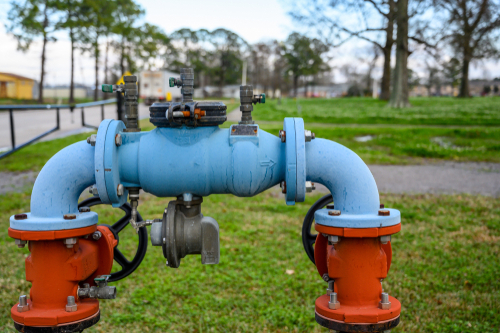
A backflow prevention device isn’t a “set it and forget it” installation. The device has internal check valves and relief valves that can wear out, stick, or fail over time. Annual testing verifies that those components are still functioning and keeping contaminated water out of your clean supply.
During a test, a certified backflow technician connects a test kit to the device and measures differential pressure across the check valves. The test confirms the valves are sealing properly and the relief port opens at the correct pressure. The whole process takes about 15 to 30 minutes and doesn’t require shutting off your water for an extended period.
If the device fails the test, the technician can usually repair or replace the failed components on the spot.
Why Licensing Matters for Backflow Work
Not every plumber is licensed to install, test, or repair backflow prevention assemblies. It requires a separate backflow certification beyond the standard plumbing license. Hiring someone without the proper credentials puts you at risk of an installation that doesn’t meet code, won’t pass inspection, and — most importantly — won’t actually protect your water supply.
At Jacob’s Plumbing LLC, we carry both a plumbing license and a backflow license, which means we can handle the full scope of backflow work — installation, testing, repair, and replacement. We serve homeowners in Greer, Pelzer, Piedmont, Williamston, and across Upstate South Carolina.
Our residential plumbing services include backflow repair and replacement as part of our standard service lineup, and we handle commercial backflow work for businesses that need annual testing and compliance documentation.
The Bottom Line
Backflow prevention isn’t glamorous, and it’s probably not the first thing on your mind when you think about plumbing maintenance. But it’s one of those things where a small investment now prevents a serious health and safety problem later. If you have an irrigation system, a pool autofill, or any cross-connected water system in your home, get the backflow preventer tested annually. It’s quick, it’s inexpensive, and it protects the water your family uses every day.
Need backflow testing or installation in Greer, SC? Call Jacob’s Plumbing LLC at (864) 318-3285. We’re one of the few local plumbers licensed for both plumbing and backflow work, and we’ll make sure your water stays safe.