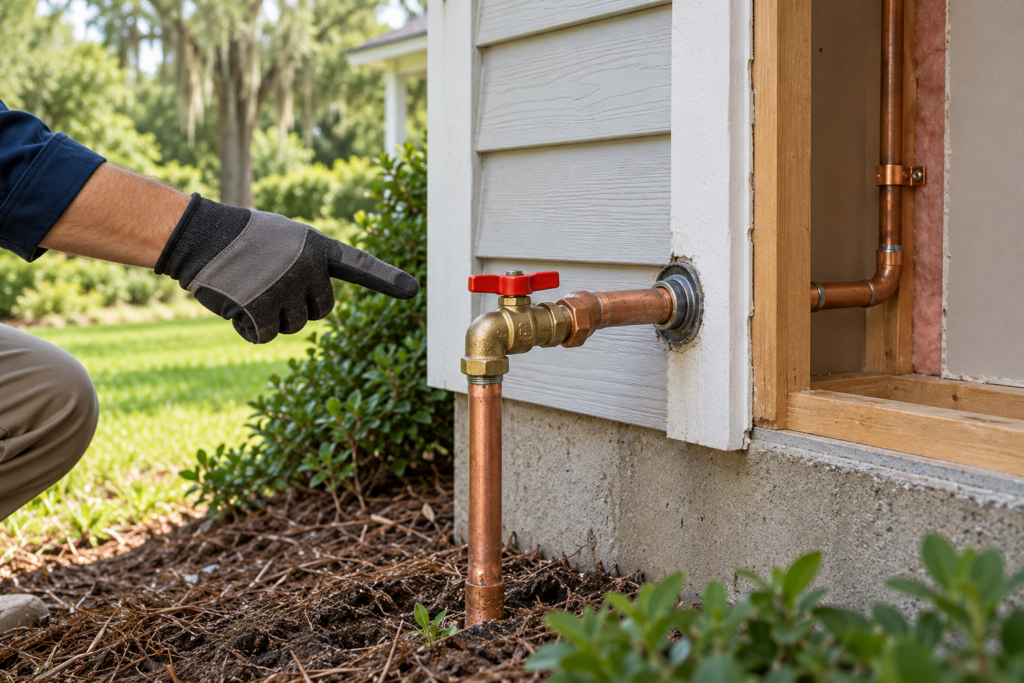
Replacing a water service line and repiping a house are different projects. The service line brings water to the home from its supply connection; interior distribution pipes carry it to fixtures. Replacing one does not automatically repair problems in the other.
If you are comparing proposals in Pelzer, ask the plumber to identify where the confirmed problem lies and where the proposed work starts and ends. Similar symptoms, including weak flow and unexplained water use, can come from either side or from something else entirely.
Locate the Boundary Before Choosing a Project
On a typical utility-connected property, the water service runs between the utility connection or meter and the home’s entry point. Ownership and repair responsibilities vary. The meter’s location alone does not establish every boundary that applies to your property.
Inside the home, cold-water distribution serves fixtures and the water heater. Hot-water piping then supplies the fixtures that use heated water. A whole-house repipe usually concerns that interior supply network, with its exact coverage defined by the proposal.
A private well, detached building, irrigation branch or later addition can make the layout more complicated. Ask for the actual connections to be traced rather than assuming that every home has one straightforward meter-to-house route.
The Same Symptom Can Have Several Causes
Low pressure at several fixtures does not prove that the underground service is damaged. It may reflect a supply condition, valve position, pressure-control issue, pipe restriction or other limitation. Measurements at relevant points help narrow the problem.
A wet area in the yard can raise concern about a buried leak, but irrigation, drainage and other water sources can look similar. The leak location should be established before digging or choosing a replacement route.
Repeated leaks inside separate rooms may support evaluation of the interior network. One damaged fitting or a limited branch defect presents a different scope from deterioration spread throughout the home.
Jacob’s Plumbing provides water line repair, replacement and repiping evaluations. Ask which part of the supply system the findings actually implicate.
What a Water Service Proposal Should Identify
A service-line replacement proposal should show the starting and ending connections, the route, the material and the access needed. It should identify what stays in place at the utility or private supply end and at the building entry.
Ask whether the main shutoff, any pressure-regulating component and the transition to interior piping are included. Those connections are easy to overlook when a quote describes only the underground pipe.
The route can cross a lawn, walkway, driveway or landscaped area. Ask which surfaces will be opened and who restores them. Backfill is not the same task as repaving or restoring irrigation.
Do not dig or probe the route yourself. Utility locating, buried-system conflicts and property access need to be considered before excavation. The chosen method must fit the site rather than a promise that every line can be replaced with minimal disturbance.
What an Interior Repipe Proposal Should Identify
An interior repipe should name the included hot and cold branches, fixture connections, shutoffs and water-heater connections. Ask whether outdoor hose bibs, an addition or a detached space are included or retained.
Supply pipes are separate from drains, vents and sewer lines. The term whole-house does not mean every plumbing system will be replaced. If drain work is recommended, ask for its findings and scope to be identified independently.
Evaluate Each System on Its Own Evidence
An exterior leak does not establish that indoor branches are deteriorated. Likewise, recurring interior leaks do not prove that the underground service has failed. A combined proposal should explain the findings supporting both projects.
Replacing a leaking buried pipe can stop that leak while leaving an interior restriction untouched. Replacing indoor branches can improve their condition while leaving a failing service line in use. Clarifying the boundary prevents an incomplete solution.
Ask how the plumber assessed retained piping and what remains uncertain. No inspection of accessible pipe can guarantee the condition of every concealed section, but the recommendation should distinguish direct findings from reasonable limitations.
Compare Access and Restoration Responsibilities
Service-line work usually concentrates access outside the home and at its entry. Interior repiping can require openings in walls, ceilings, cabinets or floors. The location of the pipe often determines the disruption more than its length.
Ask who moves belongings, protects finished rooms and closes access openings. Patching drywall, matching texture, painting and repairing tile are distinct tasks that should have clearly assigned responsibilities.
Permits, inspections and testing depend on the work and applicable requirements. Ask who arranges them and what must happen before an opening is closed or a trench is restored.
Material Choice Comes After Scope
PEX and copper are possible supply-piping materials, but material selection does not determine whether the problem is outside or inside the home. Routing, connections, protection and the requirements of the complete system still matter.
Jacob’s Plumbing explains the considerations in PEX versus copper for a whole-house repipe. First define which pipes need work; then compare the appropriate materials and installation details for that scope.
Ask which material transitions remain and whether electrical bonding considerations need qualified review when metal piping changes. Do not disconnect clamps or grounding components yourself to prepare for plumbing work.
Ask How the Diagnosis Will Be Confirmed
A clear recommendation explains the location of the suspected fault, the checks already completed and any remaining evaluation. Ask whether the scope could change after access reveals a concealed condition.
- Where the service enters the home.
- Which supply connection or meter serves the property.
- Where leaks or weak flow have been observed.
- Whether symptoms affect hot water, cold water or both.
- Which pressure or flow checks informed the diagnosis.
- The proposed work’s starting and ending points.
- Existing pipe that will remain connected.
- Included valves and fixture connections.
- Access, testing and restoration responsibilities.
- The written process for approving additional work.
A plumber may need to coordinate with the utility or a qualified well professional when the issue involves the supply side. Ask who handles that coordination so the plumbing proposal does not assume a correction outside its scope.
Prepare Repair Records Without Disturbing the System
Bring prior repair invoices, dates, photographs and notes about which fixtures are affected. Describe whether the issue began suddenly or developed gradually and whether it changes with simultaneous water use.
Identify the accessible main shutoff if you already know its location. Do not force a stuck handle, open a utility meter enclosure or shut off equipment you are not authorized to operate.
For active leakage, isolate the known accessible supply only if it is safe. Stay away from water near electrical equipment and arrange prompt professional help. Do not wait for a larger project decision before addressing an active damaging leak.
Keep Separate Work Clear in a Combined Proposal
Some homes need both service-line work and interior repiping. In that case, request separate descriptions of the findings, boundaries, access and completion checks for each system, even if one contractor performs both.
Separate scopes make it easier to decide whether the projects should be staged or completed together. They also reveal what a lower-priced alternative leaves in place.
Ask when water will be unavailable and what fixtures can be used between stages. The interruption plan should reflect the real connections being replaced, rather than a universal promise about how long a job takes.
Keep the final scope and completion records. They should show what was replaced, the material used and what was retained so future service can begin with an accurate history.
Get the Supply-Line Problem Defined in Pelzer
For a water service line or interior repipe evaluation, call Jacob’s Plumbing at (864) 318-3285. Ask for the fault location and proposed pipe boundaries to be explained before deciding which replacement project fits your home.
The useful comparison is between complete solutions to the confirmed problem. A service-line replacement and an interior repipe should not be treated as interchangeable just because both involve new water-supply pipe.